Tens and ones
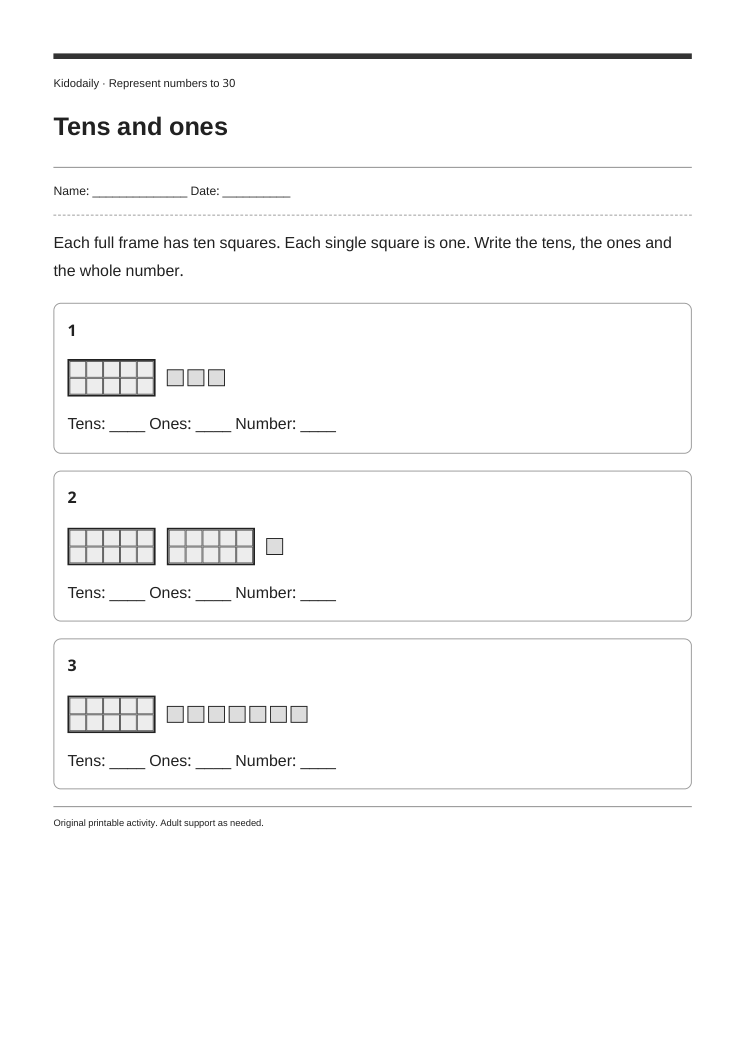
Each full frame has ten squares. Each single square is one. Write the tens, the ones and the whole number.
 Download worksheet · PDF
Parent guide and answers
From top: 1 ten and 3 ones = 13; 2 tens and 1 one = 21; 1 ten and 7 ones = 17.
23 November 2026
Original maths and science activities, plus two stories in two lengths. Free Arabic and English printables.
Print on A4 at actual size or 100%. No signup.
Each full frame has ten squares. Each single square is one. Write the tens, the ones and the whole number.
Download worksheet · PDFFrom top: 1 ten and 3 ones = 13; 2 tens and 1 one = 21; 1 ten and 7 ones = 17.
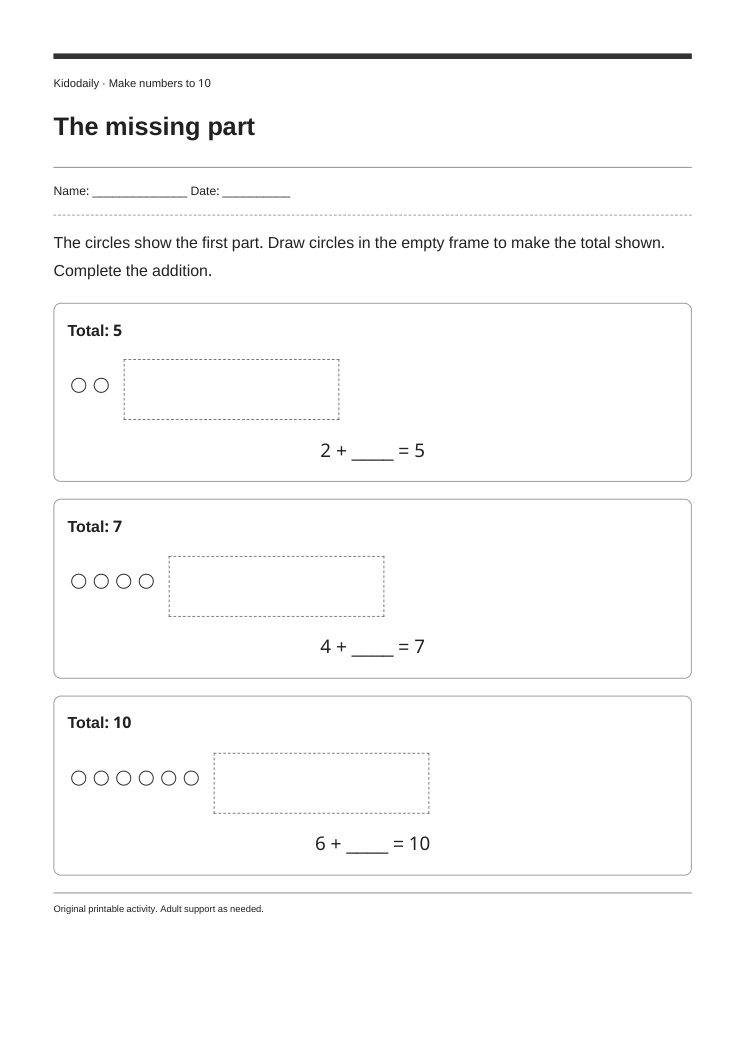
The circles show the first part. Draw circles in the empty frame to make the total shown. Complete the addition.
 Download worksheet · PDF
From top: 2 + 3 = 5; 4 + 3 = 7; 6 + 4 = 10. Accept any clear arrangement of circles.
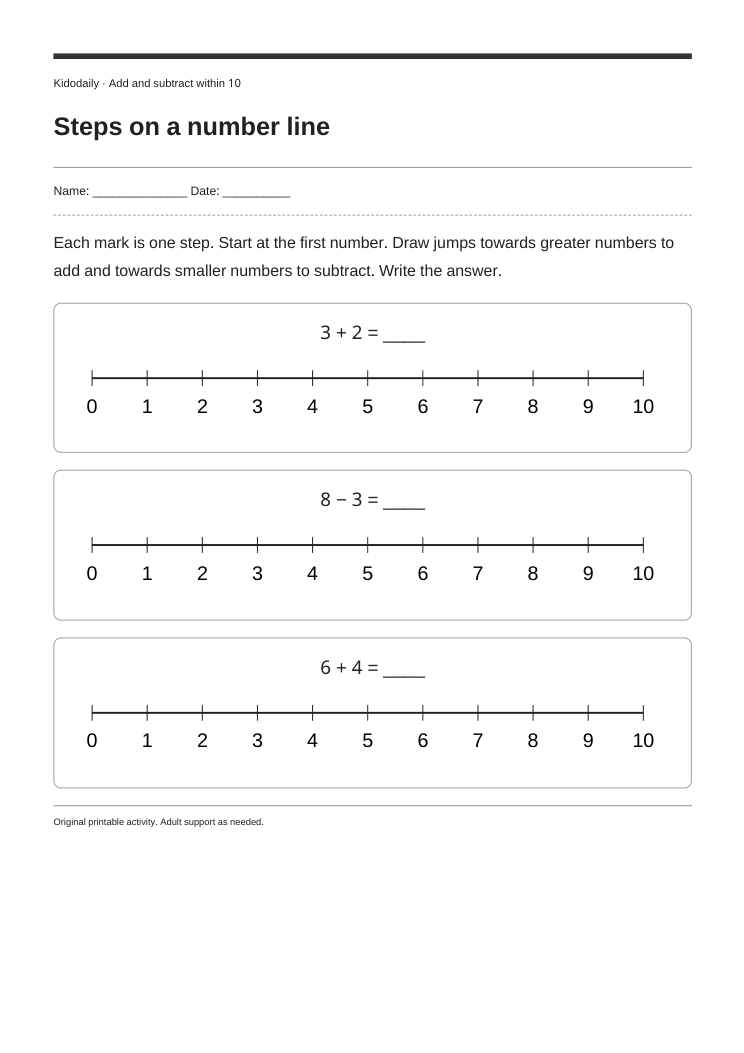
Each mark is one step. Start at the first number. Draw jumps towards greater numbers to add and towards smaller numbers to subtract. Write the answer.
 Download worksheet · PDF
From top: 5, 5, 10. Both versions use a number line from 0 at the left end to 10 at the right end.
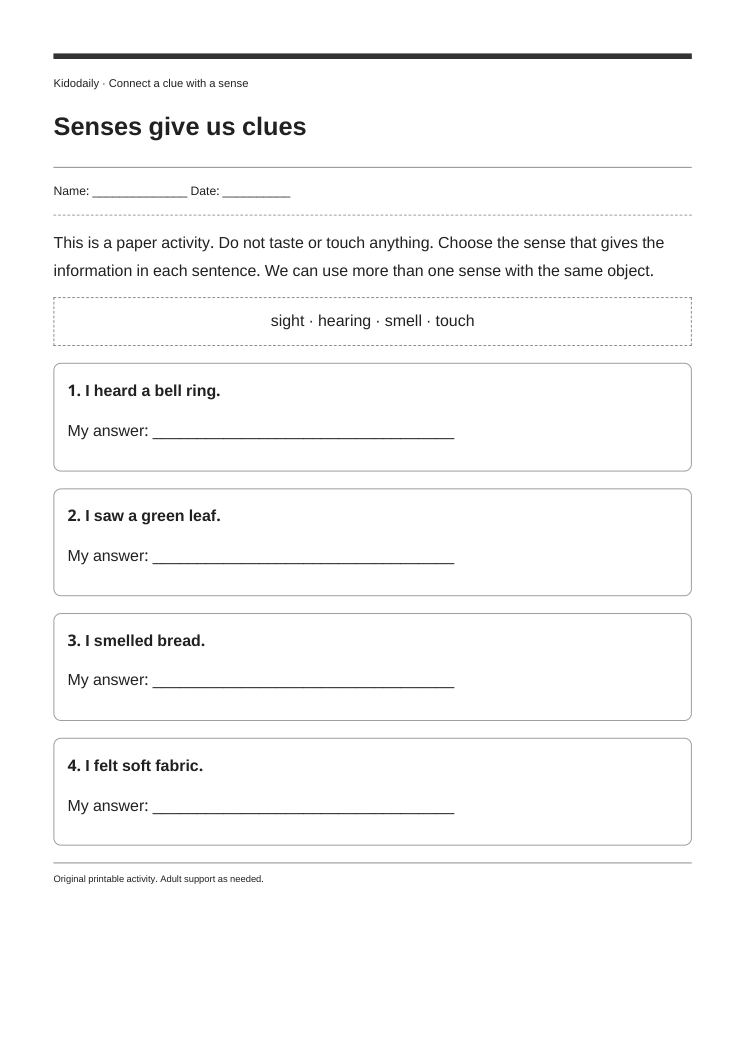
This is a paper activity. Do not taste or touch anything. Choose the sense that gives the information in each sentence. We can use more than one sense with the same object.
 Download worksheet · PDF
In order: hearing, sight, smell, touch. The stated clue determines the answer, not the object alone.
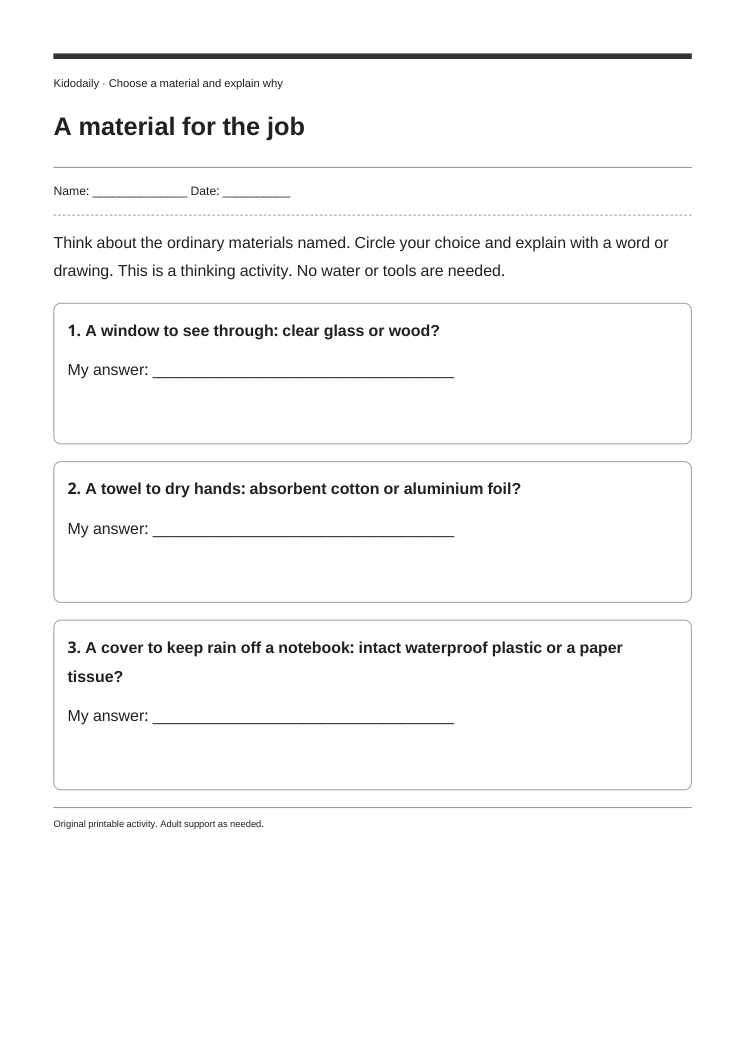
Think about the ordinary materials named. Circle your choice and explain with a word or drawing. This is a thinking activity. No water or tools are needed.
 Download worksheet · PDF
Clear glass lets us see through it; absorbent cotton takes in water; intact waterproof plastic keeps water off the notebook. Discuss the reason. Not every form of a material has the same properties. Do not test glass or water.
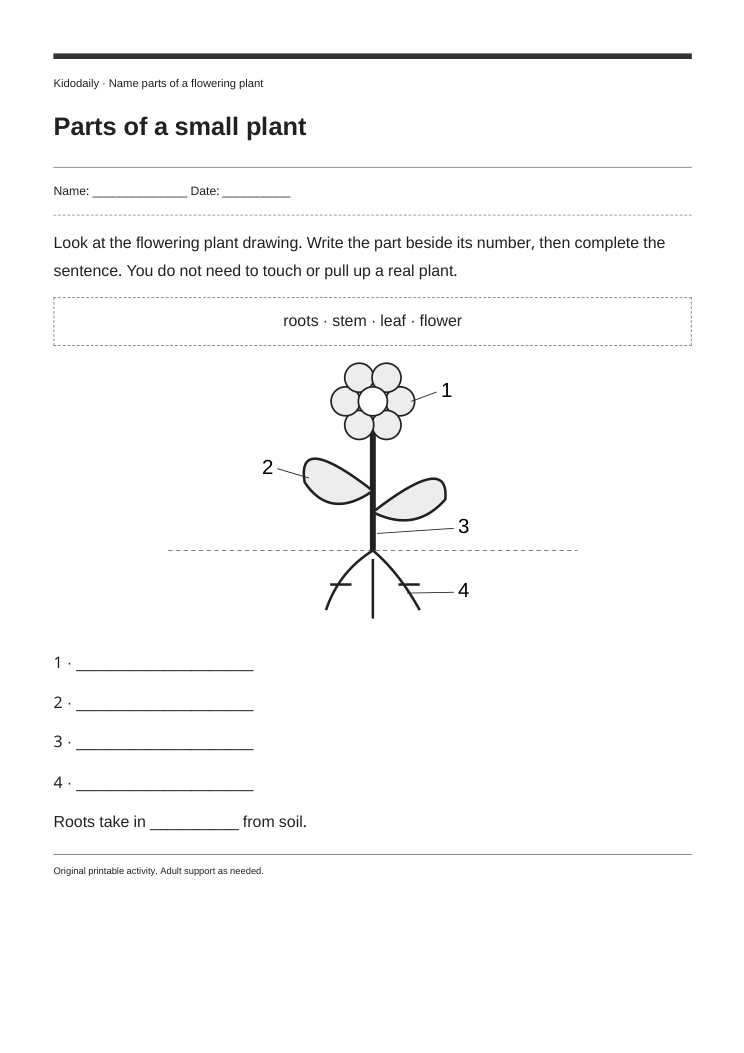
Look at the flowering plant drawing. Write the part beside its number, then complete the sentence. You do not need to touch or pull up a real plant.
 Download worksheet · PDF
1: flower. 2: leaf. 3: stem. 4: roots. Roots anchor the plant and take in water from soil. This is a simplified flowering plant, not a model of every plant.
Mariam opened the button box with Dad. She saw a big blue button. No other button looked the same. Was it alone? She put it with big buttons of other colours. Then she put it with small blue buttons. It belonged in more than one group!
Mariam was drawing a circle when Dad sat down to sort the sewing box. He invited her to look at the buttons with him, without handling sharp tools or putting anything in her mouth. She noticed a big blue button with two holes. No other button looked exactly like it. Dad grouped the large buttons together. The blue button now had neighbours of different colours. Next, he grouped the blue buttons. Its new neighbours were smaller. Mariam drew the buttons on her paper instead of moving them. Could she sort by the number of holes? Dad suggested trying it in her drawing. She drew a line around the buttons with two holes. Her button belonged there too. The button had not changed. The question about its group had changed.
How did one button belong in different groups? Draw shapes and sort them once by size and once by shape. Use drawings, not real buttons.
Sami drew a tree by the window. A small branch hid a bird. The bird had vanished! Then he heard a chirp. He waited in his seat. The branch moved and the bird appeared. Sami added a branch to his picture and wrote: chirp, chirp.
Sami sat with Mum beside a closed window and drew the tree outside. He drew the trunk and some leaves. Then he spotted a bird on a branch. He reached for his brown pencil. When he looked up, he could no longer see the bird. It had flown away, he said. Mum asked whether he had seen it fly or simply could not see it now. Sami thought about that. He had not seen it fly. A chirp came from nearby. He waited in his seat without opening or moving closer to the window. A thin branch moved in the breeze. The bird appeared behind the leaves. It had been hidden. Sami wrote under his picture: I could not see it. Then I heard it. Then I saw it. His page held clues from his eyes and ears, and an idea he had changed.
What is the difference between not seeing the bird and seeing it fly away? Draw something that could hide behind a leaf in a picture.
Descriptive lengths, not standardized reading levels.